From sea floor to stone
How an ammonite becomes a fossil, and why geologists love them.
How this site works. Every fact is in our own words and linked to its source, beside it. Where good sources disagree, we show each version in a “Sources differ” box.
Turning to stone
Rapid burial by sediment that had settled out of water is needed for a fossil to form. BGS, fossils
Fossils are the remains of plants and animals buried in sediments such as sand and mud under ancient seas, lakes and rivers. BGS, fossils
Soft parts rot soon after death, but hard parts such as shells, bones and teeth can be replaced by minerals that harden into rock. BGS, fossils
Usually the coiled shell is the only part of an ammonite that is preserved. BGS
The commonest way is petrification by permineralisation: mineral-rich water soaks through a buried shell or bone and minerals such as calcium carbonate or silica fill and finally replace it. BGS, fossils
If the shell dissolves away it can leave a hollow in its shape, a mould. Sediment can later fill the hollow to make a matching cast. BGS, fossils
Fossils are usually found in sedimentary rock, formed when sand, silt, mud or the shells of sea creatures settle in layers that are pressed together. NHM, fossils
The word fossil comes from the Latin fossilis, meaning ‘unearthed’. BGS, fossils
Fossils include any preserved trace of life that is usually more than 10,000 years old. BGS, fossils
Fool’s gold
Some ammonites look as if they were dipped in gold. The colour comes from iron pyrite, often called fool’s gold. NHM, snakestones
Pyrite reacts with air and moisture, and that can make a fossil fall apart. NHM, fossils
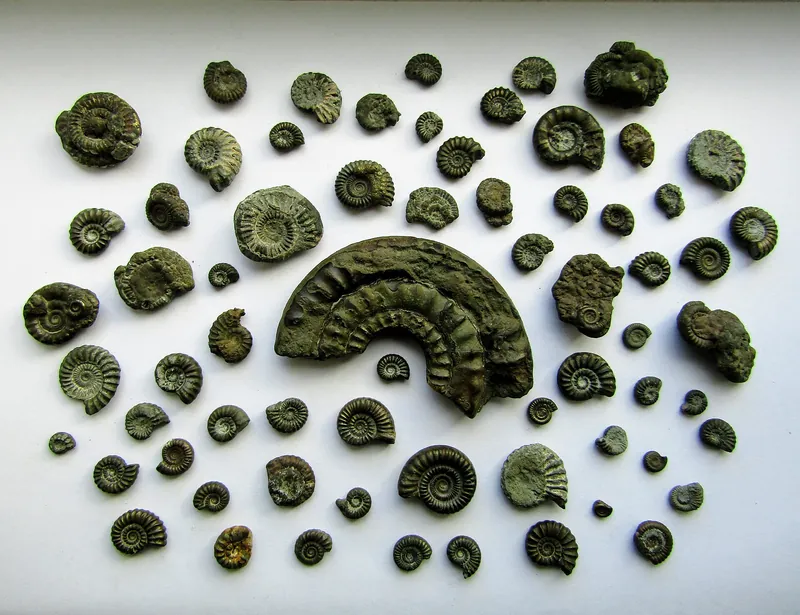
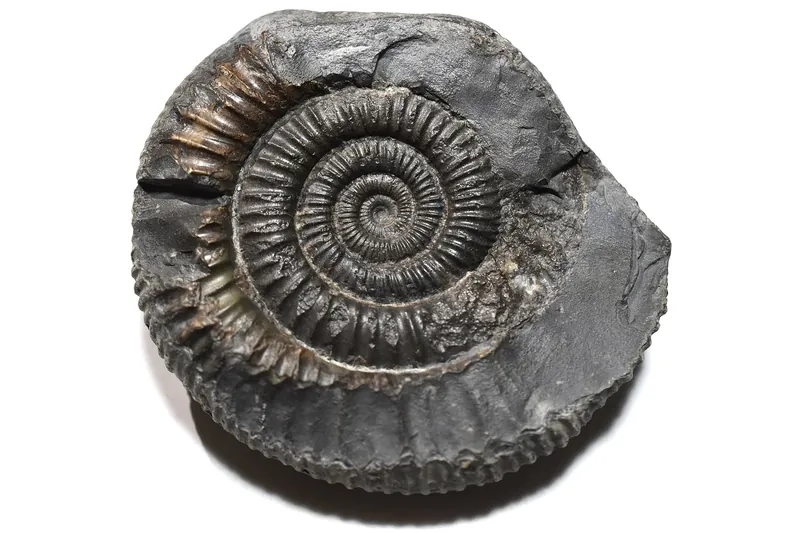
Some Cretaceous ammonites keep much of their original shell, which gives them a pearly shine. NHM, snakestones
Clocks in the rocks
Index fossils are used to work out the age of sedimentary rocks: finding the same one in different places shows the rocks formed at about the same time. NHM, fossils
Because ammonites were common and evolved fast, much of Europe’s Mesozoic rock has been divided into ‘ammonite zones’. NHM
They make excellent guide fossils: each species lasted a fairly short time, they turn up in many kinds of marine rock, they are common and quite easy to identify, and they lived worldwide. BGS
Ammonites can pin down slices of geological time less than 200,000 years long, which is very precise for Earth history. BGS
Ammonites evolved so quickly that sampling up through layers of rock shows the changes from one layer to the next. NHM
Britannica also calls ammonoids important index fossils, for their wide spread, rapid evolution and easily recognised features. Britannica
The ammonite pioneers
Using ammonites to date rocks was pioneered in the 1850s by two Germans, Friedrich Quenstedt and his former pupil Albert Oppel. BGS
Their work used the ammonites of southern Germany’s Swabian and Franconian Alb, part of the range that runs on from the Jura Mountains, which gave the Jurassic its name. BGS
Lyme Regis is known for a near-complete Jurassic ammonite zonation, and for the marine reptile fossils first collected by Mary Anning. IUGS
Our view: an ammonite is a fossil and a clock in one. Name the species and you have narrowed the age of the rock around it to a very short slice of time.
Next: the Jurassic Coast →