The fossil hunter of Lyme Regis
Poor, largely self-taught and shut out of the scientific societies, she found some of the most important fossils of her age.
How this site works. Every fact is in our own words and linked to its source, beside it. Where good sources disagree, we show each version in a “Sources differ” box.
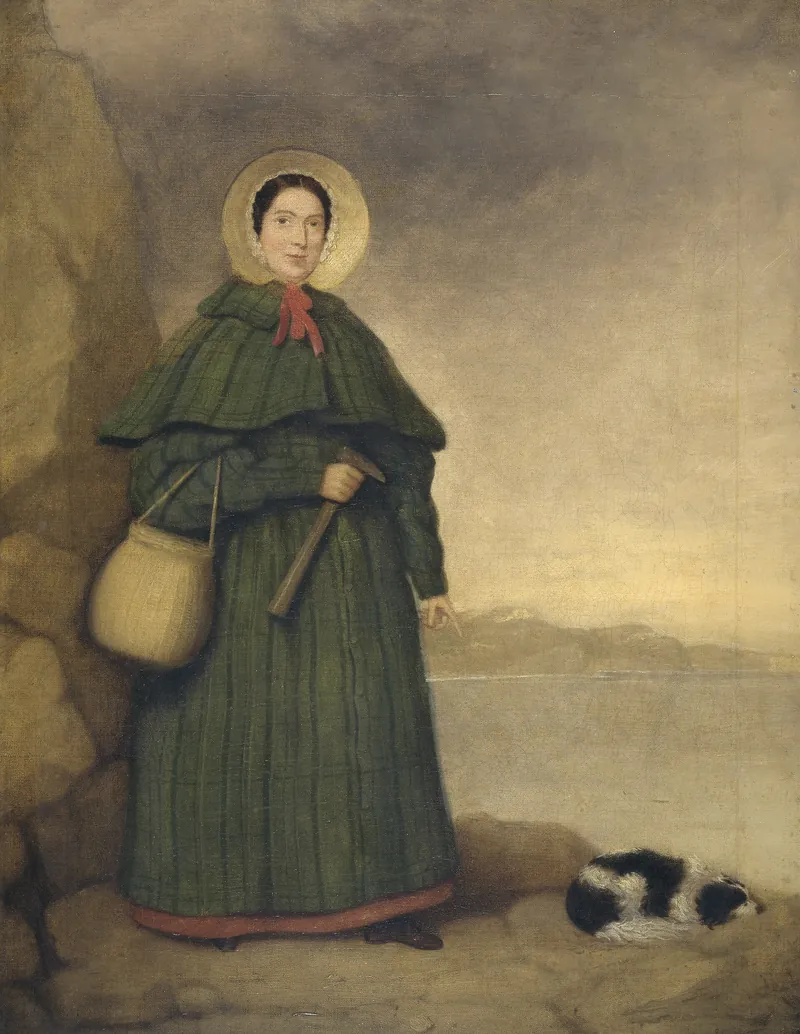
Childhood
Mary Anning was born in Lyme Regis in 1799. NHM, Mary Anning
Her birthday was 21 May 1799. BBC News
The family were very poor dissenters, Protestants outside the Church of England. NHM, Mary Anning
How many brothers and sisters? Sources differ
- The Natural History Museum says only Mary and her older brother Joseph, out of nine children, survived to adulthood. NHM, Mary Anning
- The Geological Society says her parents had at least nine children, and only two grew up. Geological Society
- BBC News says she was one of 10 children, and eight of her nine brothers and sisters died before adulthood. BBC News
All three agree that only Mary and Joseph grew up. The total is less certain; the Geological Society says “at least”.
Her father Richard was a cabinetmaker and amateur fossil collector who taught her to find and clean fossils, and sold them from his shop. NHM, Mary Anning
By the age of five or six, Mary was helping him collect fossils. NHM, Mary Anning
She had little formal education but could read, and taught herself geology and anatomy. NHM, Mary Anning
She even dissected modern fish and cuttlefish to understand the fossils she found better. BBC News
Fossils for sale
Richard died in 1810, and Mary helped pay off the family’s debts by selling her finds. NHM, Mary Anning
How old was she when her father died? Sources differ
- Mary later told a visitor that her father died when she was ten. Wandering the shore, she picked up a fossil and showed it to a lady collector, who gave her half a crown. Geological Society
- BBC News says she was 11 when he died. BBC News
Mary’s own account, as a visitor remembered it, says ten; the museum’s date of 1810 makes her 11, as BBC News says.
Lyme Regis was especially rich in ammonites, then called ‘Ammon’s horn’, and in belemnites, the ‘devil’s fingers’. NHM, Mary Anning
In the Napoleonic Wars, people holidayed at home, and tourists flocked to seaside towns like Lyme Regis. NHM, Mary Anning
The first ichthyosaur
The first big find: sources differ on who and when
- In autumn 1811, when Mary was 12, Joseph found a strange fossil skull. In November 1812 Mary dug out the outline of its five-metre skeleton, the Natural History Museum says. NHM, Mary Anning
- BBC News says that in 1811, aged just 12, Mary discovered a 5.2 m (17 ft) skeleton, now known to be an ichthyosaur. BBC News
The museum credits Joseph with the skull in 1811 and Mary with the skeleton in 1812; BBC News gives the whole find to Mary in 1811. The sizes agree.
By 1820 it had been recognised as an extinct marine reptile and named Ichthyosaurus, ‘fish lizard’. It was the first ichthyosaur to be studied scientifically. NHM, Mary Anning
Today the specimen is called Temnodontosaurus platyodon, and it is in the Natural History Museum’s collections. NHM, Anning’s fossils
Plesiosaurs, pterosaurs and poo
In December 1823 Mary found the first complete skeleton of a Plesiosaurus, ‘near to reptile’. NHM, Mary Anning
The great French naturalist Georges Cuvier at first thought it might be a fake. The Geological Society of London held a special meeting about it, but Mary was not invited. NHM, Mary Anning
Once convinced, Cuvier sent someone to buy a specimen for Paris. Mary bought one from another collector and sold it to him for three times the price. NHM, Anning’s fossils
In December 1828 she found a jumble of bones with wings and a long tail: the first pterosaur found outside Germany, now known as Dimorphodon. NHM, Mary Anning
She also pioneered the study of coprolites, which is fossilised poo. NHM, Mary Anning
A More Ancient Dorset
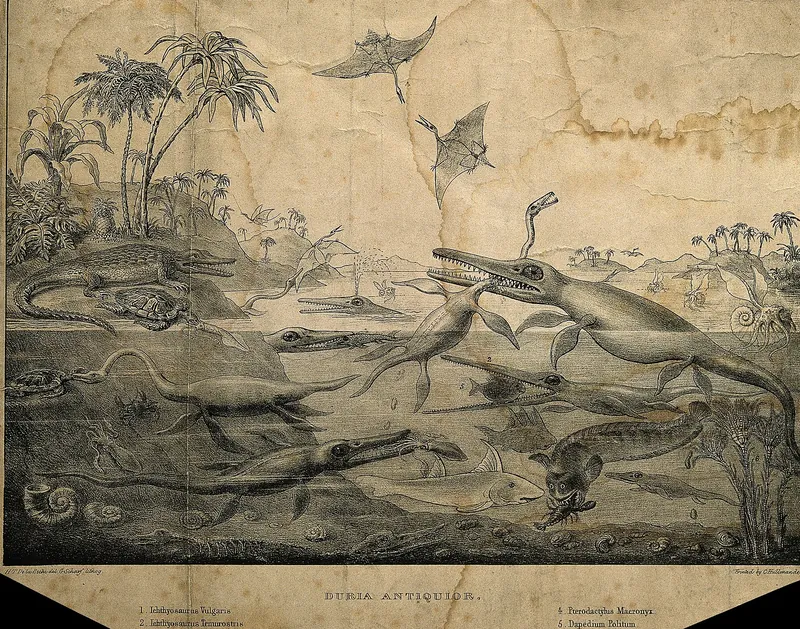
In 1830 her childhood friend Henry De la Beche painted Duria Antiquior, ‘A More Ancient Dorset’, and sold prints to raise money for her. NHM, Mary Anning
It was the very first picture of prehistoric life based on fossil evidence, the start of what is now called palaeoart. NHM, Mary Anning
Left out
Male scientists who bought her fossils often didn’t credit her in their papers. NHM, Mary Anning
Because of her gender, she was never a member of the Geological Society. Geological Society
The Geological Society did not admit women as Fellows until 1908. NHM, Mary Anning
As far as we know, her only published writing is a short extract from a letter, printed in 1839. NHM, Anning’s fossils
Death and memory
Mary Anning died in 1847, aged only 47, still short of money. NHM, Mary Anning
Henry De la Beche, by then president of the Geological Society, read a tribute to her at a meeting, breaking the society’s members-only tradition. BBC News
She is buried at St Michael the Archangel Church in Lyme Regis. BBC News
Three years later, members of the Geological Society paid for a stained-glass window in her memory in the church where she is buried. BBC News
Lyme Regis Museum stands, by chance, on the site of her birthplace and family home. BBC News
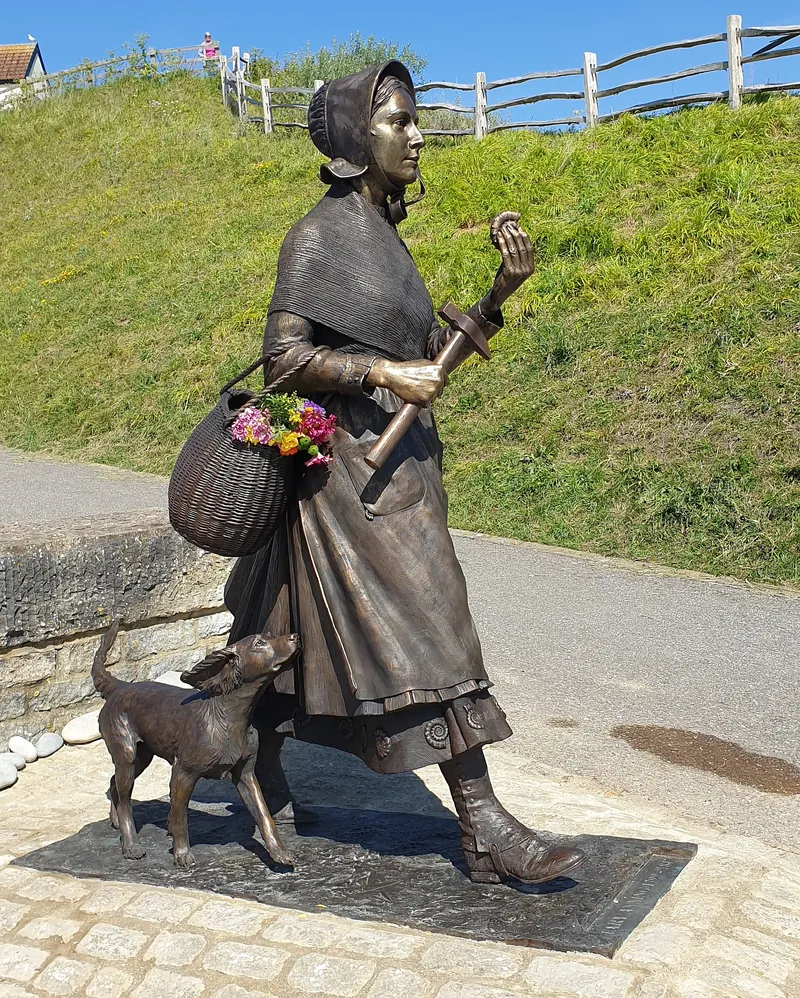
In 2022 a statue of Mary and her dog was unveiled in Lyme Regis, after a campaign started by 11-year-old Evie Swire. NHM, Mary Anning
She has also been honoured with special Royal Mail stamps and a 50p coin. NHM, Mary Anning
Several species are named after her, but only one, the fish Acrodus anningiae, during her lifetime. NHM, Anning’s fossils
In 2015 a study proposed that one of her ichthyosaurs was a new species, now called Ichthyosaurus anningae. NHM, Anning’s fossils
The 2020 film Ammonite, with Kate Winslet as Mary, is not a biopic: its director says so. BBC News
Timeline
- 1799 Mary Anning was born in Lyme Regis in 1799. NHM, Mary Anning
- 1810 Richard died in 1810, and Mary helped pay off the family’s debts by selling her finds. NHM, Mary Anning
- 1811 to 1812 In autumn 1811, when Mary was 12, Joseph found a strange fossil skull. In November 1812 Mary dug out the outline of its five-metre skeleton, the Natural History Museum says. NHM, Mary Anning
- By 1820 By 1820 it had been recognised as an extinct marine reptile and named Ichthyosaurus, ‘fish lizard’. It was the first ichthyosaur to be studied scientifically. NHM, Mary Anning
- December 1823 In December 1823 Mary found the first complete skeleton of a Plesiosaurus, ‘near to reptile’. NHM, Mary Anning
- December 1828 In December 1828 she found a jumble of bones with wings and a long tail: the first pterosaur found outside Germany, now known as Dimorphodon. NHM, Mary Anning
- 1830 In 1830 her childhood friend Henry De la Beche painted Duria Antiquior, ‘A More Ancient Dorset’, and sold prints to raise money for her. NHM, Mary Anning
- 1839 As far as we know, her only published writing is a short extract from a letter, printed in 1839. NHM, Anning’s fossils
- 1847 Mary Anning died in 1847, aged only 47, still short of money. NHM, Mary Anning
- 1908 The Geological Society did not admit women as Fellows until 1908. NHM, Mary Anning
- 2015 In 2015 a study proposed that one of her ichthyosaurs was a new species, now called Ichthyosaurus anningae. NHM, Anning’s fossils
- 2022 In 2022 a statue of Mary and her dog was unveiled in Lyme Regis, after a campaign started by 11-year-old Evie Swire. NHM, Mary Anning
Our view: Mary Anning is often remembered as a collector who sold fossils. The sources show someone who also understood what she was finding, and was rarely given the credit.