How ammonites lived, and how they vanished
Hundreds of millions of years in the sea, then an asteroid.
How this site works. Every fact is in our own words and linked to its source, beside it. Where good sources disagree, we show each version in a “Sources differ” box.
How old?
When did they start? Sources differ
- The Natural History Museum says the wider group Ammonoidea first appeared about 450 million years ago. NHM
- Britannica says ammonoid fossils are found in rocks from the Devonian Period, which began 419 million years ago, to the end of the Cretaceous, 66 million years ago. Britannica
- The British Geological Survey says ammonites lived in the Jurassic and Cretaceous, a span of about 140 million years. BGS
- The ‘true ammonites’, the Ammonitida, are known from the Jurassic Period, from about 200 million years ago. NHM
The sources are counting different groups. The museum and Britannica mean the wider group, the ammonoids, which goes back hundreds of millions of years. The BGS and the museum’s “true ammonites” mean the Jurassic and Cretaceous ammonites alone.
The Jurassic began about 201 million years ago and the Cretaceous ended about 66 million years ago. BGS
Three kinds of suture
Three groups followed one another, each with a more complicated suture. The goniatites, with simple sutures, flourished in the Palaeozoic Era, 541 to 252 million years ago. Britannica
The ceratites, with more folded sutures, came next and were most common in the Triassic, 252 to 201 million years ago. Britannica
Most of them died out at the end of the Triassic, but a few survived and gave rise to many forms with the intricate ‘ammonite’ suture. Britannica
Where did they live?
Ammonites lived all over the world, and only in the sea. NHM
So if you find an ammonite in a rock, the place you are standing was once under the sea. NHM, fossil sites
How deep could they go? Sources differ
- The Natural History Museum says they tended to live in shallower seas, perhaps down to about 400 metres. NHM
- The British Geological Survey says they could probably not cope with depths of more than 100 metres. BGS
Both sources put ammonites mainly in shallow seas. They differ on the limit by a factor of four, so we give both.
Tiny to giant
Ammonites ranged from a few millimetres across to many times bigger. Big ones were more common from the Late Jurassic onwards. NHM
Some species were tiny; others were as big as a person. NHM, fossil sites
The Late Jurassic Nannocardioceras was tiny: complete adults are rarely more than 20 mm across. BGS
How big was the biggest? Sources differ
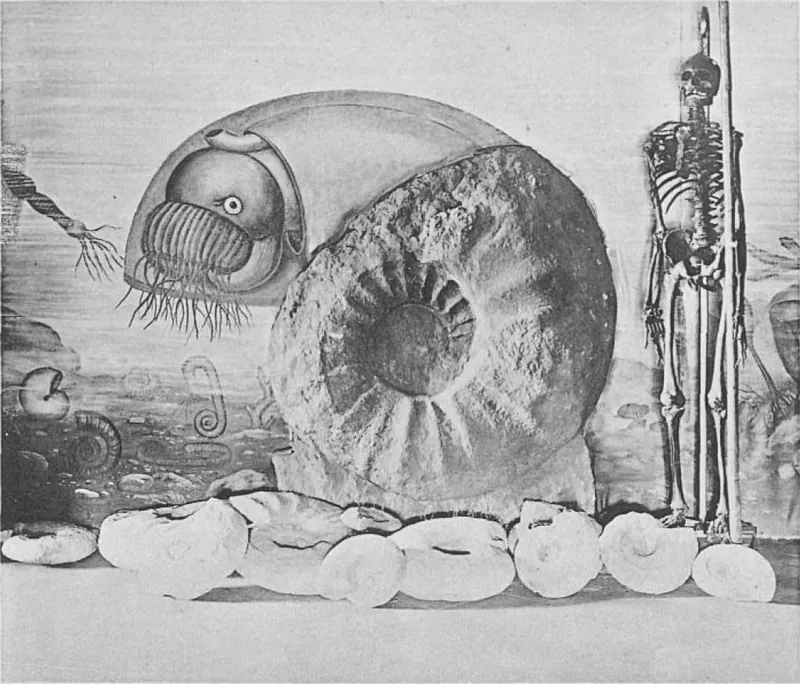
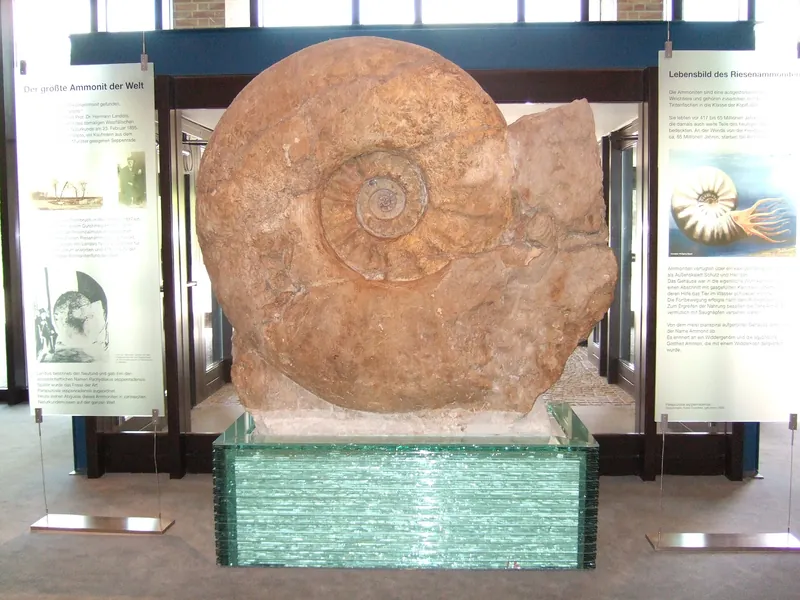
- The largest known species is Parapuzosia seppenradensis, from the Late Cretaceous. The Natural History Museum says the largest specimen is 1.8 metres across and incomplete; whole, it could have been 2.5 to 3.5 metres. NHM
- The British Geological Survey gives the same specimen as 1.95 m across, found in Germany in 1895, and about 2.55 m if complete. BGS
- Britannica measures the shell of Pachydiscus seppenradensis (an older name) at 205 centimetres and calls it probably the largest shelled mollusc ever. Britannica
All three are describing the same famous giant, found in Germany. Its size depends on who measured it and how; Britannica uses an older genus name.
What did they eat?
What ammonites ate: sources differ
- Depending on their size, ammonites probably ate much what cephalopods eat today, such as crustaceans, bivalves and fish. Smaller species probably ate plankton, and some may have scavenged. NHM
- Britannica says nearly all ammonoids are thought to have been predators, with evidence that they ate zooplankton, crustaceans and other ammonoids. Britannica
- The British Geological Survey suggests small plankton or plants on the sea floor, slow-moving animals of the seabed, and drifting or dead sea creatures. BGS
Nobody has watched an ammonite feed, so each source gives its best reading of the evidence. They overlap on plankton and crustaceans.
What ate them?
Ammonites were food for others too: there is evidence that mosasaurs and ichthyosaurs ate them, and fish probably did. NHM
Their enemies included marine reptiles, crustaceans, fish and even other ammonites. BGS
The end
Most ammonites died out with the non-avian dinosaurs at the end of the Cretaceous, when an asteroid hit Earth. NHM
A long impact winter stopped photosynthesis on land and in the sea, cutting off food. That was devastating for ammonites. NHM
Britannica notes a theory that a sudden fall in plankton at the end of the Cretaceous finished off the last ammonoids. Britannica
Not quite all went at once: a few species lived on into the Palaeogene in the Western Interior Seaway before dying out. NHM
Nautiluses survived, probably partly because they live in deeper water, which was less affected, and because their larger hatchlings were less limited by the size of food. NHM
Still telling us things
After extinctions, many shelled animals shrink because they lack the resources to grow, so ammonite sizes can help scientists study past climate change. NHM
Studies of the chemistry of the shells, called sclerochronology, are starting to show how long ammonites might have lived. NHM