Myths, magic and legends
Before anyone knew what they were, people all over the world told stories about ammonites.
How this site works. Every fact is in our own words and linked to its source, beside it. Where good sources disagree, we show each version in a “Sources differ” box.
Snakestones
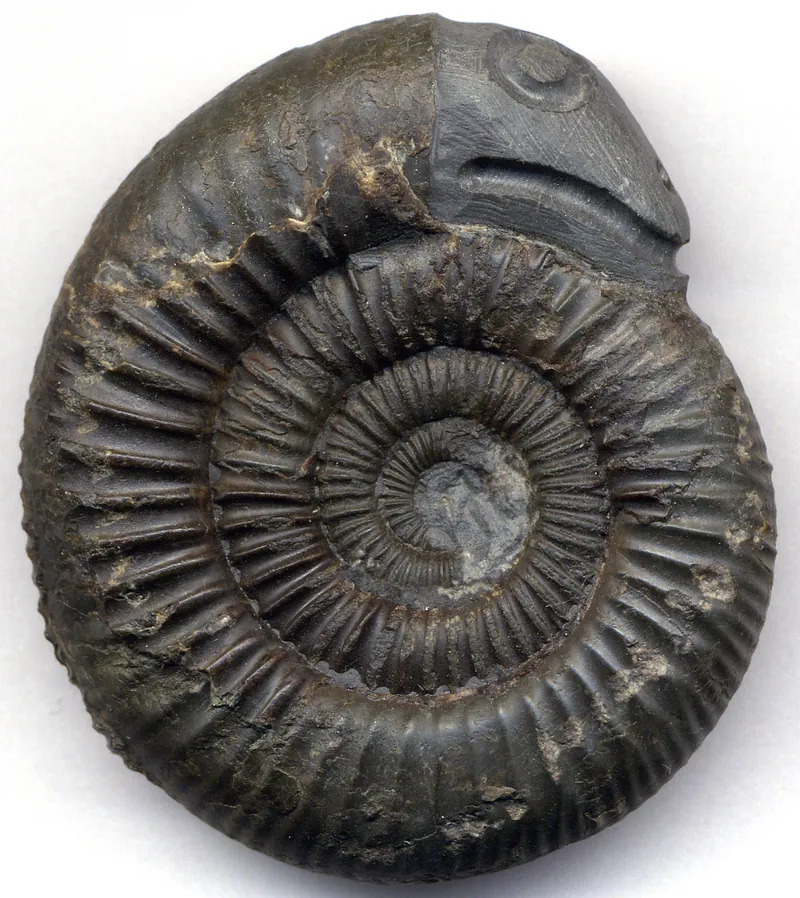
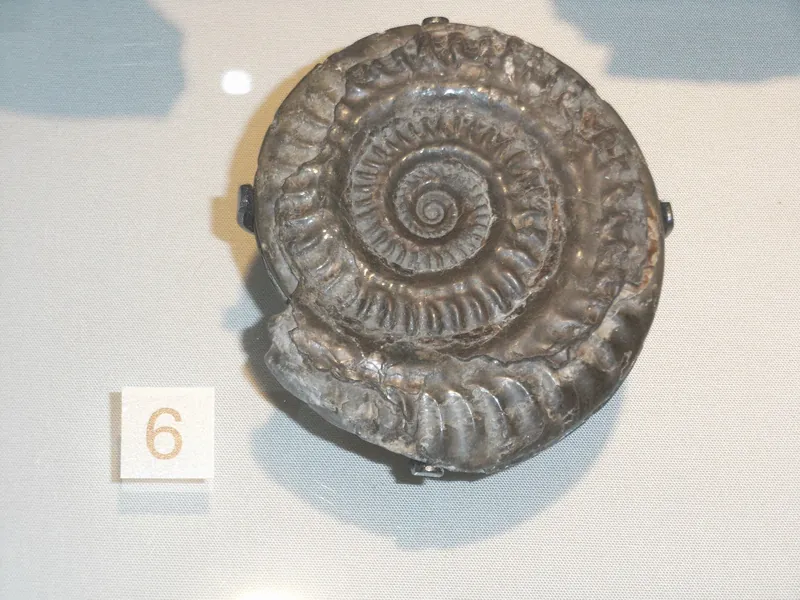
In England, ammonite fossils were called snakestones, because they look like coiled snakes turned to stone. NHM, snakestones
But ammonites weren’t reptiles at all. They were sea-dwelling molluscs. NHM
Snakestone stories came mainly from two places where ammonites are common: Whitby in Yorkshire and Keynsham in Somerset. NHM, snakestones
In his book Britannia of 1586, William Camden wrote that if you broke them open you found ‘stony serpents, wreathed up in circles, but eternally without heads’. NHM, snakestones
Who carved the heads? Sources differ
- To back up the legend, and to sell them more easily, Victorians carved snake heads on ammonites. NHM, snakestones
- The British Geological Survey says local collectors and dealers often carved heads on them. BGS
The two accounts fit together: the carving was done to sell fossils as snakes.
St Hilda of Whitby
In Whitby the legend goes back to Saint Hilda (614–680), the Saxon abbess who was to found an abbey there. She is said to have turned the town’s snakes to stone and thrown them off the cliffs. NHM, snakestones
The ammonite Hildoceras bifrons, one of the commonest at Whitby, is named after her. NHM, snakestones
Sir Walter Scott told the story in his poem Marmion: ‘Of thousand snakes, each one / Was changed into a coil of stone’. NHM, snakestones
Whitby’s coat of arms includes three snakestones. BGS
Some versions bring in St Cuthbert, a seventh-century monk said to have cast a beheading curse on the snakes, which explains why snakestones have no heads. NHM, snakestones
Keynsham and the fairies
In Keynsham the story is that St Keyna turned the serpents of the woods to stone by prayer. NHM, snakestones
Other stories said snakestones had once been fairies, turned into snakes and then into stone. NHM, snakestones
Horns of Ammon
Where does the name come from? Sources differ
- The Natural History Museum says early Greeks linked ammonites with the horned god Jupiter Ammon and called them Cornu Ammonis, ‘horns of Ammon’, the origin of the name ammonite. NHM, snakestones
- The British Geological Survey says ammonites take their name from the Egyptian god Amun, whom the Greeks called Zeus Ammon and showed with curling ram’s horns. BGS
Both trace the name to the ram-horned god Ammon. The museum talks about the Greek and Roman god, Jupiter Ammon; the BGS goes back to the Egyptian god Amun.
Many ammonite names end in -ceras, from the Greek keras, meaning horn. BGS
Lyme Regis was especially rich in ammonites, then called ‘Ammon’s horn’, and in belemnites, the ‘devil’s fingers’. NHM, Mary Anning
Around the world
Ammonites have fascinated people since at least the Middle Stone Age, and have been found on every continent. NHM, snakestones
Ancient Romans believed that sleeping with a golden, pyrite ammonite from Ethiopia under the pillow could help you dream the future. NHM, snakestones
In Hindu culture, black stones holding ammonites are called saligrams, and are treasured because they look like the disc, or chakra, held by the god Vishnu. NHM, snakestones
True saligrams come only from the valley of the Gandaki River in Nepal and northern India. Sanskrit texts mention them over 2,200 years ago. NHM, snakestones
In Chinese folklore ammonites were Jiaoshih, horn stones, because they look like coiled rams’ horns. NHM, snakestones
The 11th-century Chinese scientist Su Sung described a ‘stone-serpent’ shaped like a coiled snake with no head or tail-tip, adding that nobody knew what animal had been turned to stone. NHM, snakestones
The Blackfoot people of North America called ammonites insikim, buffalo stones, because they look like sleeping bison, and used them in ceremonies to bring bison herds in. NHM, snakestones
It was believed buffalo stones could have babies, perhaps because ammonites tend to break apart along their septa. NHM, snakestones
In New Guinea, the Tifalmin people of the Upper Sepik River used ammonites as charms for hunting and farming. NHM, snakestones
Farmers in Germany’s Harz Mountains called them dragonstones, and put one in the milk pail to bring back a cow’s milk. NHM, snakestones
In parts of Scotland they were crampstones, used on cows with cramp. NHM, snakestones
Ammonites have been collected more than 5,000 metres above sea level in the Himalayas. NHM, snakestones
Myths, checked
MythAmmonites were snakes turned to stone.
FactBut ammonites weren’t reptiles at all. They were sea-dwelling molluscs. NHM Ammonites were sea animals with shells: extinct cephalopods, the group that includes today’s squid, octopuses and nautiluses. NHM
MythSnakestones were found with their heads on.
FactIn his book Britannia of 1586, William Camden wrote that if you broke them open you found ‘stony serpents, wreathed up in circles, but eternally without heads’. NHM, snakestones To back up the legend, and to sell them more easily, Victorians carved snake heads on ammonites. NHM, snakestones
MythAmmonites were basically nautiluses.
FactA 2021 study of a rare fossil with soft parts found evidence that squid, octopuses and cuttlefish might be closer relatives of ammonites than had been thought. Imperial College The same study found muscles that nautiluses do not have, so ammonites and the nautilus may be less alike than was thought. Imperial College
MythAmmonites had lots of tentacles, like a nautilus.
FactThe museum’s fossil curator thinks ammonites more likely had eight arms than the many tentacles of a nautilus. NHM No fossil of ammonite arms has been found yet, so much of what we know about the soft body is inferred from living cephalopods. NHM
MythThe animal filled its whole shell.
FactThe animal lived only in the last chamber, the body chamber. The earlier chambers held gas or fluid, which it could adjust to rise, sink and move, much like a submarine. BGS
MythAll ammonites coil in a flat spiral.
FactShells could be loosely or tightly coiled, flat or twisted like a corkscrew, and some started as a tight spiral and then straightened out. NHM Nipponites mirabilis, found in Japan, is exceptionally rare and looks a bit like a knot. NHM
MythAmmonites lived in the deep ocean.
FactThe Natural History Museum says they tended to live in shallower seas, perhaps down to about 400 metres. NHM The British Geological Survey says they could probably not cope with depths of more than 100 metres. BGS
MythEvery ammonite died out in the same instant as the dinosaurs.
FactNot quite all went at once: a few species lived on into the Palaeogene in the Western Interior Seaway before dying out. NHM
MythAmmonites are rare fossils.
FactThey died out about 66 million years ago, and their fossils turn up all around the world, sometimes in huge numbers. NHM Ammonites are among the commonest fossils on the Dorset coast, so ordinary finds don’t need recording, though unusual species or very large shells are worth recording. West Dorset Code
MythYou can take any ammonite you find on Monmouth Beach.
FactBut visible water-worn ammonites, especially on Monmouth Beach, must be left, and the ammonite pavement must not be damaged. Undercliffs Code
MythThe film Ammonite is the true story of Mary Anning.
FactThe 2020 film Ammonite, with Kate Winslet as Mary, is not a biopic: its director says so. BBC News
Our view: the snakestone legends got one thing right. These really are the remains of animals turned to stone, just not snakes.